Amazon Adventure
Clinical Vignette
A 39-year-old man returned from a 9-month sabbatical traveling along the Amazon River in Colombia near the borders of Peru and Brazil. During his stay, he participated in indigenous ceremonies, sustained minor lacerations while cutting trees, and was scratched by monkeys. He reports multiple insect bites (mosquitoes and possibly sand flies), and a single episode of unprotected sexual activity. He also observed wildlife including pink dolphins, monkeys, and birds.
Two months after returning, he presents with a slowly enlarging, firm, keloid-like lesion on his lower leg. There is no pain, systemic symptoms, lymphadenopathy, or mucosal involvement.
A skin biopsy is performed. Grocott methenamine silver (GMS) staining reveals oval yeast-like structures with birefringent membranes, arranged both isolated and in chains resembling “Rosario beads.”
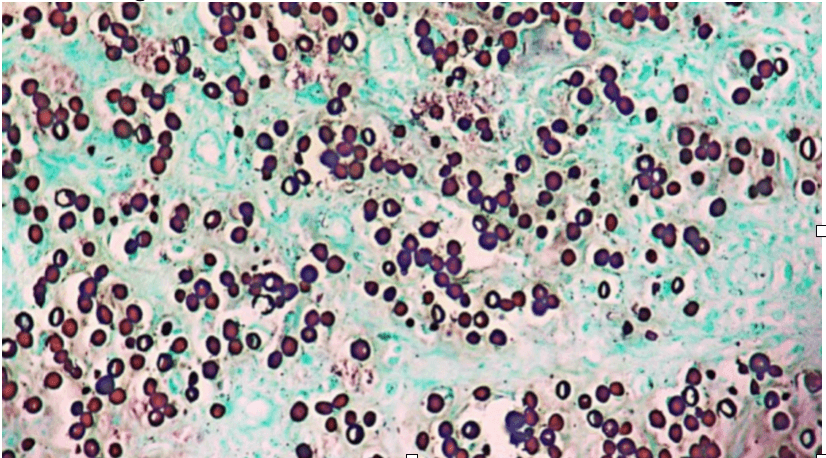
Obtained from: "https://www.dovepress.com/lobomycosis-epidemiology-clinical-presentation-and-management-options-peer-reviewed-fulltext-article-TCRM"
Question
Which of the following is the most likely causative organism?
Select one answer to view the rationale and peer response data.
Rationale locked
Answer the question above to reveal the rationale.
Rationale locked
Answer the question above to reveal the rationale.
References
Queiroz-Telles F, Fahal AH, Falci DR, Caceres DH, Chiller T, Pasqualotto AC. Neglected endemic mycoses. The Lancet Infectious Diseases. 2017;17(11):e367–e377.