When molluscum is not molluscum
Clinical Vignette
A 36-year-old man presents with four weeks of fever, progressive weight loss, fatigue, and multiple painless skin lesions. He recently returned to the United States after spending several years working in northern Thailand. He reports chronic cough, intermittent diarrhea, and profound weakness.
He was diagnosed with HIV infection six months earlier but has not yet started antiretroviral therapy. He denies recent travel outside Southeast Asia and has no known tuberculosis contacts. He recalls frequent exposure to soil during the rainy season while working in rural areas.
On examination, he appears cachectic and febrile. Numerous umbilicated papules and nodules are scattered across the face, trunk, and upper extremities, resembling molluscum contagiosum. Generalized lymphadenopathy and mild hepatosplenomegaly are present. Laboratory studies reveal anemia, leukocytosis, and a CD4 count of 38 cells/μL.
Blood cultures are pending. A biopsy of a skin lesion demonstrates intracellular yeast-like organisms within macrophages.
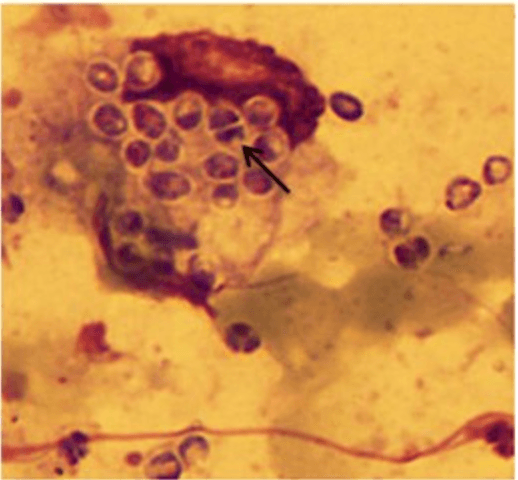
Yeast forms demonstrating characteristic transverse septa (GMS stain).
Question
Which of the following is the most likely diagnosis?
Select one answer to view the rationale and peer response data.
Rationale locked
Answer the question above to reveal the rationale.
Rationale locked
Answer the question above to reveal the rationale.
References
Brown L, Ngo Thi Hoa, Vo Trieu Ly, Li L, Cao C, Youngchim S, Chayakulkeeree M, Bicanic T, Chan JF-W, Yuen K-Y, Le T. Recent Advances in the Diagnosis of Talaromycosis. Clinical Infectious Diseases. 2025;81(6):e533–e543.
Wang F, Han R, Chen S. An Overlooked and Underrated Endemic Mycosis—Talaromycosis and the Pathogenic Fungus Talaromyces marneffei. Clinical Microbiology Reviews. 2023;36:e00051-22.