HistorID
When Influenza Meant the Stars
A disease that kills half a million people a year is named after a Renaissance belief that the stars make you sick. The word influenza means influence — the influence of celestial bodies flowing into human bodies. That belief was wrong. The name stayed.
The word influenza encodes a theory that was already wrong when the word was coined. Like malaria with its 'bad air,' influenza preserves a pre-scientific explanation in everyday clinical speech. The name outlasted the theory by 400 years. That durability is not a flaw. It is a reminder that medical language often keeps what the science discards.
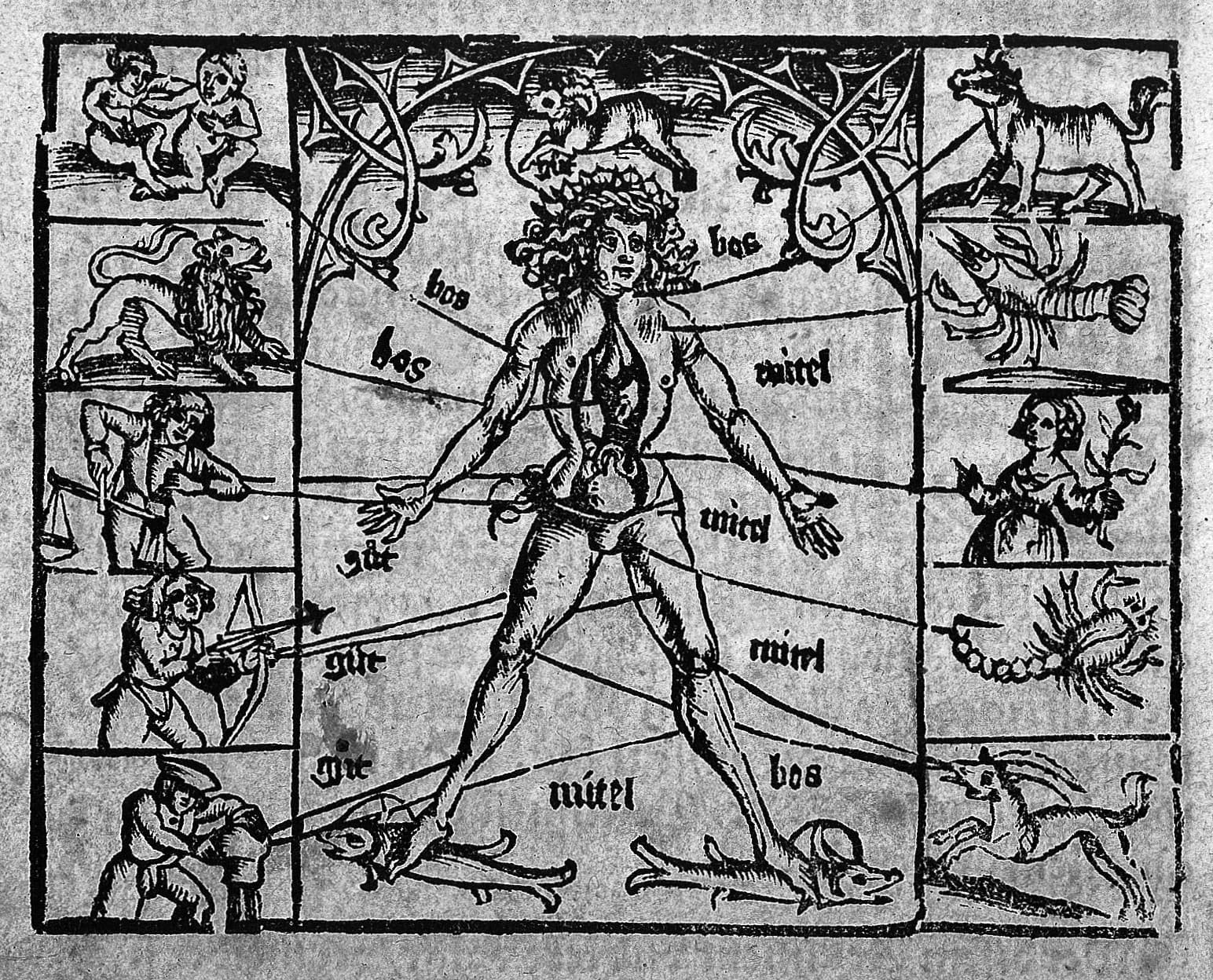
It is strange that one of the world's most familiar disease names is a 500-year-old astrological term. Influenza kills hundreds of thousands of people every year, strains virology labs and vaccine programs to their limits, and occupies entire wings of public health agencies. And its name, spoken in every clinic during flu season, means the influence of the stars. The word is a fossil from a time when epidemics were not caused by viruses but by the movement of celestial bodies. That belief is long dead. The word is not.
Historical scene
Renaissance Italy in the early sixteenth century had no germ theory. When fevers swept through cities, physicians looked up, not down. The dominant medical framework was astrological: celestial bodies exerted an influentia — a flowing in of power — that shaped everything from the weather to the humors of the human body. This was not fringe belief. It was mainstream academic medicine, taught at universities and illustrated in the zodiac man, a woodcut showing which astrological signs governed which body parts. If a planet was out of alignment, the influence was bad, and people got sick. The Italian phrase for an epidemic was influenza di stelle — influence of the stars. The word influenza appeared in Italian medical writing as early as 1504, applied first to scarlet fever and later to the seasonal respiratory illness we now call flu.
What happened
The word shed its celestial tail and traveled. By the eighteenth century, Italian physicians had shortened the phrase to just influenza, and in 1743 an outbreak that began in Italy and spread across Europe carried the word into English. The Gentleman's Magazine of London reported that April: an article from Rome described a disease that had broken out there, "and they call it the Influenza." Before that, English speakers used other names. The French word grippe, from gripper meaning to seize or grasp, described the constriction of the throat and was anglicized as "the grip" — still in common use during the 1918 pandemic. Other terms included catarrh, epidemic catarrh, ague, and three-day fever. None of them stuck the way influenza did.
The astrological explanation died. The name did not. Over the nineteenth century, germ theory replaced celestial influence as the framework for understanding infectious disease. In the twentieth century, the influenza virus was isolated, its surface proteins characterized, its genome sequenced, and its subtypes catalogued from H1 to H18. At each step, the old astrological name stayed right where it was. No international committee proposed renaming the disease after its virology. The word that blames the stars for a viral infection sat comfortably alongside hemagglutinin, neuraminidase, and R0 calculations.
Why it changed infectious diseases
Influenza is not alone in this. Malaria means bad air. The common cold was once attributed to cold drafts. Medical language is full of words that encode theories nobody believes anymore, and that is not an accident. These old names often captured something real, even when their explanations were wrong. Renaissance physicians who blamed influenza on the stars were recording a genuine epidemiologic pattern: winter epidemics. The stars did not cause them, but the astrologers noticed the seasonality. That same kind of observation, stripped of its cosmology, becomes surveillance data. The word influenza preserves the moment when pattern recognition outran mechanism.
Why the stars still matter now
Every flu season, clinicians, epidemiologists, and public health officials use a Renaissance Italian word to describe a modern viral threat. Nobody believes the stars are involved. But the word stayed because it works. It is short, it is memorable, and it names a recognizable clinical picture that has been with us for at least five centuries. The enduring lesson is not that Renaissance astrologers were right. They were wrong. It is that medical language has a longer lifespan than medical theory, and sometimes the old words carry something the new ones do not: a record of how long we have been trying to understand what makes us sick.
References
Harper D. Influenza. Online Etymology Dictionary.
The Gentleman's Magazine. April 1743; Vol. XIII, p. 212. "An Article from Rome informs us that a Sort of Plague has broke out there, which destroys Abundance of their People, and they call it the Influenza."
Treccani. Influenza. Vocabolario, Istituto della Enciclopedia Italiana. Traces the Italian etymology through influenza di stelle and early 16th-century medical usage.
Potter CW. A history of influenza. J Appl Microbiol. 2001;91(4):572-579.