HistorID
When Fever Came Back on the Fifth Day
Some soldiers thought the worst had passed when the fever broke. Then it came back, with shin pain, headache, and the same lice still living in the seams of their clothes.
Bartonella quintana never belonged only to the trenches. The organism that weakened troops in World War I still returns wherever clothing, hygiene, and housing fail enough to give body lice another chance.
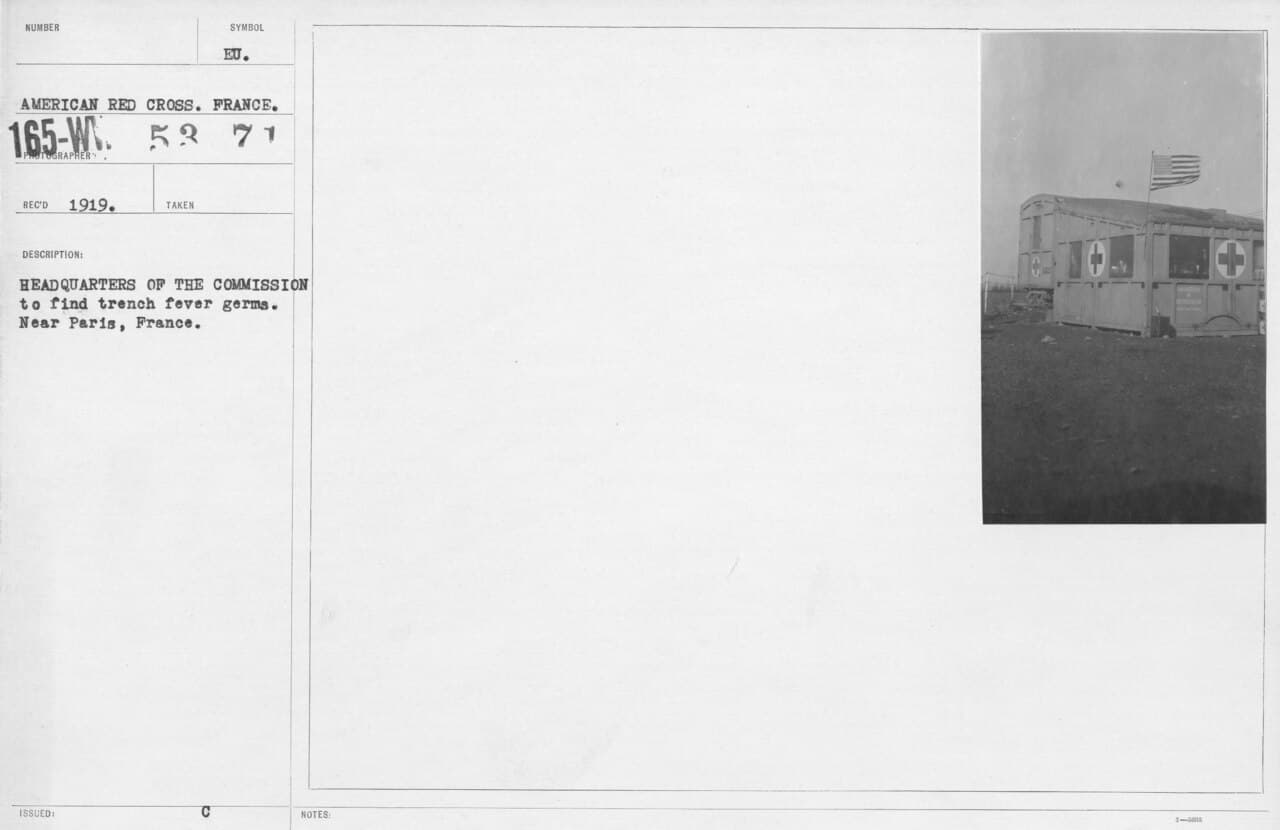
Some soldiers seemed to get better just long enough to trust the feeling. The fever dropped. The aches eased. Then the whole thing came back. Headache. Shin pain. Exhaustion. Same trench, same uniform, same lice. That repeating pattern gave the illness one of its old names: quintan fever, the fever that returned on the fifth day by older counting.
Historical scene
World War I gave trench fever exactly what it needed. Men packed into wet dugouts, wore the same clothes for long stretches, and carried body lice in their uniform seams. This was not the sort of wartime epidemic that always filled graves first. It filled infirmaries and thinned the line. Soldiers who were still alive were often too weak, too sore, or too spent to fight.
The old label stuck because the fever often had a rhythm. "Quintan" was the older word for a fever recurring on the fifth day by inclusive counting. Trench fever did not behave like a metronome in every patient, but it did it often enough for the name to feel right to the doctors watching it unfold.
What happened
During the war, trench fever became one of the signature louse-borne illnesses of the front. It announced itself with relapsing fever, headache, and the leg pains that made it hard to dismiss. The human body louse carried the infection, and the war carried the louse. Once that link became clearer, the problem stopped being just another soldier's fever. It became a problem of clothing, crowding, and military hygiene.
The organism would later settle under the name Bartonella quintana, carrying the old clinical rhythm inside the species name. The taxonomy became tidier than the history ever was. Long before the organism looked neat on paper, the disease had already taught a harder lesson: a parasite in the right social conditions can take an army apart without ever needing to look like a grand dramatic plague.
Why it changed infectious diseases
Trench fever mattered because it made living conditions part of infectious-disease thinking in a brutally concrete way. The reservoir was human. The vector was the body louse. The habitat was not some distant swamp. It was wool, seams, crowding, and infrequent washing. Once you see that, fever control and delousing become the same story.
It also changed the usual hierarchy of wartime disease. An infection did not need typhus-level mortality to matter strategically. If it sent enough soldiers out of action for long enough, it was already changing the war around them.
Why it still matters now
The organism left the trenches, but not the conditions that favor it. B. quintana is now a reemerging pathogen in people living without reliable access to showers, laundry, clean clothing, or stable shelter. That is why this is not just a war story. The presentation can now be chronic bacteremia, bacillary angiomatosis, or culture-negative endocarditis.
That modern turn is the real reason to remember the name. If a patient has unexplained fever, negative blood cultures, possible body-louse exposure, or a history shaped by unsheltered living and poor access to hygiene, B. quintana belongs on the list. The disease sounds antique right up until it lands on a modern heart valve.
References
Anstead GM. The centenary of the discovery of trench fever, an emerging infectious disease of World War 1. Lancet Infect Dis. 2016;16(8):e164-e172.
Ruiz J. Bartonella quintana, past, present, and future of the scourge of World War I. APMIS. 2018;126(11):831-837.
Foucault C, Brouqui P, Raoult D. Bartonella quintana characteristics and clinical management. Emerg Infect Dis. 2006;12(2):217-223.
Raoult D, Roux V. The body louse as a vector of reemerging human diseases. Clin Infect Dis. 1999;29(4):888-911.
Shepard Z, Vargas Barahona L, Montalbano G, Rowan SE, Franco-Paredes C, Madinger N. Bartonella quintana Infection in People Experiencing Homelessness in the Denver Metropolitan Area. J Infect Dis. 2022;226(Suppl 3):S315-S321.
Keller M, Agladze M, Kupferman T, et al. Bartonella quintana Endocarditis in Persons Experiencing Homelessness, New York, New York, USA, 2020-2023. Emerg Infect Dis. 2024;30(12):2494-2501.
Quintan fever. Historical medical dictionary entry.