HistorID
The Woman Behind henselae
The name behind cat scratch disease did not begin with a cat. It began with blood cultures, AIDS-era vascular lesions, and a microbiology technologist whose isolates helped define a new pathogen.
Bartonella henselae is a naming story with a diagnostic lesson: fastidious organisms can hide behind familiar syndromes, and the people who keep difficult cultures alive can shape what clinicians learn to recognize.
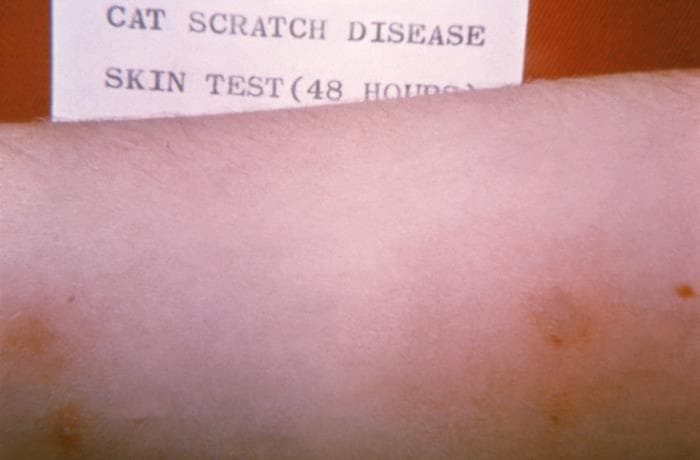
The name behind cat scratch disease did not start with a kitten and a swollen lymph node. It started in the early AIDS era, when patients developed fever, bacteremia, and vascular skin lesions that could look frighteningly close to Kaposi sarcoma. The organism was slow, fussy, and easy to miss. When it finally got a name, part of that name belonged to Diane M. Hensel.
Historical scene
In the late 1980s and early 1990s, clinicians were seeing illnesses that did not fit old categories cleanly. Bacillary angiomatosis produced red-purple vascular lesions in people with advanced HIV. Peliosis could turn the liver or spleen into a field of blood-filled spaces. Blood cultures sometimes yielded tiny Gram-negative organisms that did not behave like routine bacteria. The mystery sat at the intersection of bedside dermatology, AIDS medicine, and the stubborn patience of the clinical microbiology lab.
What happened
In 1992, investigators proposed a new species: Rochalimaea henselae. The organism was linked to septicemia, bacillary angiomatosis, and parenchymal bacillary peliosis. The species epithet honored Diane M. Hensel, a technologist in the clinical microbiology laboratory at University Hospitals in Oklahoma City, because she had isolated many of the strains that made the species recognizable.
That detail matters. Eponyms often preserve the names of senior physicians or famous investigators. Here, the name points toward a different kind of work: recovering a difficult organism from blood, keeping enough isolates in view, and turning scattered clinical signals into a species that could be discussed, tested, and taught.
Why the name changed
The first name did not last long. In 1993, taxonomists proposed unifying Rochalimaea with Bartonella, and Rochalimaea henselae became Bartonella henselae. The change made the organism part of a wider genus that already carried older stories of trench fever, Carrion's disease, erythrocyte invasion, endothelial infection, and vector-borne transmission. The honorific stayed. The genus moved.
The cat scratch twist
Cat scratch disease added another layer of confusion. For a time, Afipia felis looked like a plausible culprit. Then serology, culture, PCR, epidemiology, and animal studies pulled the field toward B. henselae. The organism first named in the context of bacteremia and AIDS-associated vascular disease became the name clinicians now attach to a much more familiar syndrome: regional lymphadenitis after a cat scratch.
Why it still matters
B. henselae still refuses to stay in one clinical box. It can cause lymphadenitis, bacillary angiomatosis, peliosis hepatis, neuroretinitis, culture-negative endocarditis, and vasculitis-like presentations that fool teams into chasing autoimmune disease first. Its name is a small historical marker inside a modern diagnostic habit: when the syndrome is odd, the culture is negative, and the exposure history includes cats, fleas, or immunosuppression, think beyond the usual bacteria.
References
Welch DF, Pickett DA, Slater LN, Steigerwalt AG, Brenner DJ. Rochalimaea henselae sp. nov., a cause of septicemia, bacillary angiomatosis, and parenchymal bacillary peliosis. J Clin Microbiol. 1992;30(2):275-280.
Regnery RL, Anderson BE, Clarridge JE 3rd, Rodriguez-Barradas MC, Jones DC, Carr JH. Characterization of a novel Rochalimaea species, R. henselae sp. nov., isolated from blood of a febrile, human immunodeficiency virus-positive patient. J Clin Microbiol. 1992;30(2):265-274.
Brenner DJ, O'Connor SP, Winkler HH, Steigerwalt AG. Proposals to unify the genera Bartonella and Rochalimaea, with descriptions of Bartonella quintana comb. nov., Bartonella vinsonii comb. nov., Bartonella henselae comb. nov., and Bartonella elizabethae comb. nov., and to remove the family Bartonellaceae from the order Rickettsiales. Int J Syst Bacteriol. 1993;43(4):777-786.
Chomel BB. Cat-scratch disease. Rev Sci Tech. 2000;19(1):136-150.
Giladi M, Avidor B, Kletter Y, et al. Cat scratch disease: the rare role of Afipia felis. J Clin Microbiol. 1998;36(9):2499-2502.