HistorID
The Spindle That Broke Panama
Fusarium means 'spindle' in Latin, named for the canoe-shaped macroconidia. In the 1890s, this soil-borne fungus appeared in the banana plantations of Panama, killing plants from the roots up and contaminating soil for decades. The Gros Michel banana, the only variety the world ate, could not be saved. The industry abandoned the land and moved on. The spindle-shaped spore had broken an industry.
Fusarium oxysporum f. sp. cubense causes Panama disease, a soil-borne vascular wilt that persists in soil for decades. The genus Fusarium was named by Link in 1809 from the Latin fusus, spindle, describing the canoe-shaped macroconidia. Gros Michel was commercially extinct by the 1960s, replaced by Cavendish. TR4, a new race that kills Cavendish, now threatens global banana production. Fusarium species also cause human disease: keratitis in contact lens wearers and invasive fusariosis in neutropenic patients, with mortality exceeding 50 percent.
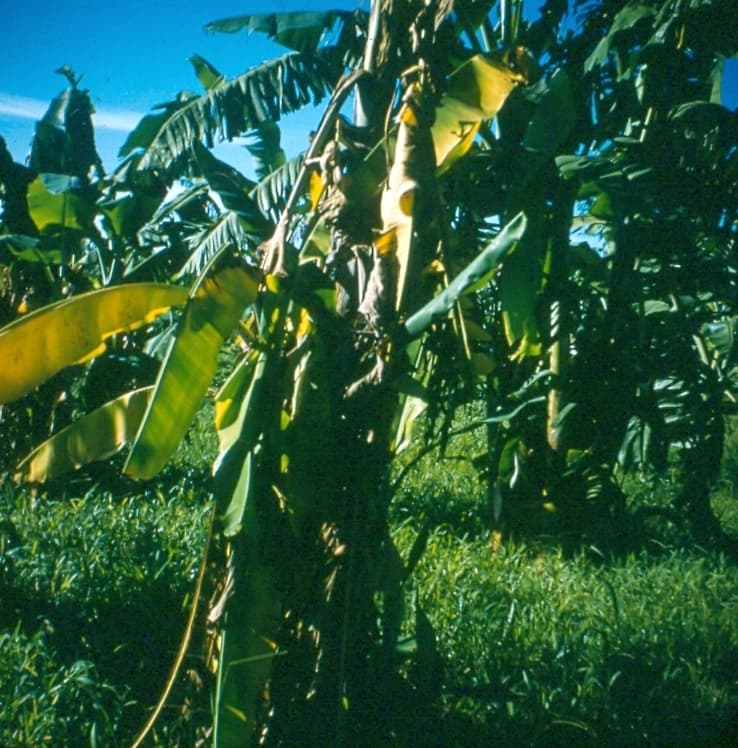
Fusarium means "spindle" in Latin. Under a microscope, the macroconidia are canoe-shaped, fusiform, pointed at both ends. They look delicate. They are not. In the 1890s, a special form of this fungus adapted to bananas appeared in the plantations of Panama and Costa Rica. It entered through the roots, colonized the xylem, and killed the plant from the inside, blocking water transport with mycelium and gels and tyloses the host produced in a losing attempt to wall the fungus off. The leaves yellowed, wilted, and collapsed around the pseudostem. The fungus sporulated into the soil. The soil would not grow a commercial banana again for decades.
Historical scene
At the turn of the twentieth century, the United Fruit Company controlled vast territories across Central America and Colombia. It was an American corporation headquartered in Boston that owned land, railroads, ports, telegraph lines, and, effectively, the governments of the countries in which it operated. Its product was the Gros Michel banana, a thick-skinned, sweet variety that traveled well in the holds of refrigerated ships and ripened predictably in distribution warehouses. Gros Michel, called "Big Mike" by workers, was essentially the only banana variety eaten in the United States and Europe. Every plant on every plantation was a clone of every other plant, propagated vegetatively from suckers and rhizomes. Genetic uniformity is efficient for an agricultural corporation. It is suicidal for a plant species confronted by a pathogen.
What happened
The disease was first noticed in the 1870s in Australia, but the epidemic that changed history began near the turn of the century in Central America. It was called Panama disease because the earliest mass devastation of commercial plantations occurred there. The name stuck before anyone understood the pathogen. The causal organism, a soil-borne fungus, was identified in 1910 by the American plant pathologist Erwin F. Smith working with samples from diseased plantations. In 1940, William Snyder and H. N. Hansen formally named the pathogen Fusarium oxysporum f. sp. cubense. The genus name came from the spindle shape of the spores. The species epithet oxysporum meant sharp-spored, from the pointed ends of those same macroconidia. The forma specialis designation, abbreviated f. sp., indicated this was a host-specific variant adapted to banana, and the word cubense, meaning "of Cuba," preserved the location of the laboratory that first characterized it.
The biology of the disease dictated the economic response. The fungus produces chlamydospores, thick-walled survival structures that persist in soil for more than thirty years. No chemical treatment could eradicate it. No crop rotation was economically feasible. No resistant Gros Michel cultivar existed. United Fruit did the only thing its business model permitted: it walked away. It abandoned infected plantations in Panama and Costa Rica, cut down new sections of tropical forest, planted new Gros Michel suckers, and repeated the cycle when the wilt appeared again. Between 1900 and 1940, the company abandoned tens of thousands of acres across Central America and Colombia. The abandoned land was ecologically degraded by decades of monoculture and chemically contaminated with a persistent pathogen. Workers who had built communities around the plantations were displaced. The term "banana republic," coined by O. Henry in 1904 to describe a fictional country modeled on Honduras, described something real: entire national economies dependent on a single crop controlled by a foreign corporation, and that crop was dying from the roots up.
By the 1950s, Gros Michel was commercially extinct. The banana that had defined the industry for half a century could no longer be grown at scale in the Americas. United Fruit and its competitors, Standard Fruit and Del Monte, pivoted to a replacement variety discovered in Southeast Asia: Cavendish. It was resistant to the Race 1 strain of Fusarium oxysporum f. sp. cubense. It was thinner-skinned and less flavorful than Gros Michel, but it could be grown in the contaminated soil. The switch from Gros Michel to Cavendish was completed by 1965. It was one of the largest and fastest crop substitutions in the history of industrial agriculture. The banana in every supermarket today is a Cavendish. It is also a clone. Every Cavendish plant on every continent is genetically identical to every other, propagated vegetatively from the same stock. The lesson of monoculture vulnerability was available, but the industry had no economic incentive to learn it.
In the 1990s, a new strain of the fungus emerged in Southeast Asia. Tropical Race 4, or TR4, is not controlled by the genetic resistance that protected Cavendish from Race 1. It kills Cavendish. It has spread from Taiwan and Indonesia to the Philippines, China, Australia, Africa, the Middle East, and, as of 2019, Colombia, the heart of the original epidemic. The same pathogen, in a slightly different genetic variant, is repeating the same story on the same crop under the same conditions of clonal monoculture. The spindle-shaped spores have a hundred years of operational experience. The banana industry does not.
Why it changed infectious diseases
Fusarium is not only a plant pathogen. The same genus that destroyed the banana industry also causes human disease, and the biology that made it devastating in soil has direct clinical consequences. In tissue, Fusarium produces septate, acutely branching hyphae that look nearly identical to Aspergillus species. A pathologist reading a biopsy cannot reliably distinguish them. The diagnosis requires culture. This is clinically urgent because the antifungal that treats Aspergillus, voriconazole, is also active against most Fusarium species, but Fusarium solani is relatively resistant to voriconazole and may require lipid amphotericin B or posaconazole instead. You need the species. You cannot get it from histopathology alone.
Fusarium has a distinctive clinical feature that helps when the laboratory result is delayed. In approximately 40 to 50 percent of cases of disseminated fusariosis, blood cultures are positive. This is unusual for molds. Aspergillus fungemia is rare, even in patients dying of invasive aspergillosis. The difference is adventitious sporulation. Fusarium produces conidia inside blood vessels at the site of infection, and those spores enter the bloodstream continuously. On skin, this process produces distinctive ecthyma gangrenosum-like lesions with central necrosis and an erythematous halo. A biopsy of the lesion may show hyphae and sporodochia penetrating the vessel wall. This finding, coupled with positive blood cultures in a neutropenic patient, makes disseminated fusariosis the leading diagnosis. The survival rate in disseminated disease is approximately 30 to 50 percent even with appropriate therapy. Recovery of the neutrophil count is the single strongest predictor of survival, more important than any antifungal. The hyphae in the blood vessel walls target patients whose immune systems cannot organize a response. The spindle-shaped spores kill the same way in a banana stem and a human capillary.
Why the spindle still matters now
The story of Fusarium and the banana is not over. It is being retold in real time. TR4 has now reached every major banana-producing continent. Cavendish may follow Gros Michel into commercial extinction within decades. Plant breeders are searching for resistance in wild banana species and developing genetically modified Cavendish lines, but the replacement cycle takes years and the fungus adapts faster than the breeding programs. Agricultural systems based on clonal monocultures are inherently vulnerable to soil-borne vascular wilt pathogens. This is not a banana problem. It is a structural problem, and Fusarium is the organism that exposes it.
The word Fusarium means "spindle." Johann Link named it in 1809 for the shape of a spore he saw under his microscope. He could not have imagined that the same spore would collapse an industry, influence the politics of Central America, determine the banana variety eaten by billions of people, and kill immunocompromised patients half a world and two centuries away. The name describes a shape. The organism describes a principle: a monoculture is a feast for a pathogen, and soil never forgets.
References
Link HF. Observationes in ordines plantarum naturales. Dissertatio I. Mag Ges Naturf Freunde Berlin. 1809;3:3-42.
Snyder WC, Hansen HN. The species concept in Fusarium. Am J Bot. 1940;27(2):64-67.
Ploetz RC. Fusarium wilt of banana. Phytopathology. 2015;105(12):1512-1521.
Nucci M, Anaissie E. Fusarium infections in immunocompromised patients. Clin Microbiol Rev. 2007;20(4):695-704.
Dita M, Barquero M, Heck DW, Mizubuti ESG, Staver CP. Fusarium wilt of banana: current knowledge on epidemiology and research needs toward sustainable disease management. Front Plant Sci. 2018;9:1468.