HistorID
The Mold That Went to War
Fleming noticed the mold in 1928. That was the famous part. The harder part was turning a fragile laboratory finding into enough drug to matter on a battlefield.
Penicillin still teaches a humbling lesson: discovery alone does not change medicine. Purification, manufacturing, and distribution are what turn a scientific clue into survival.
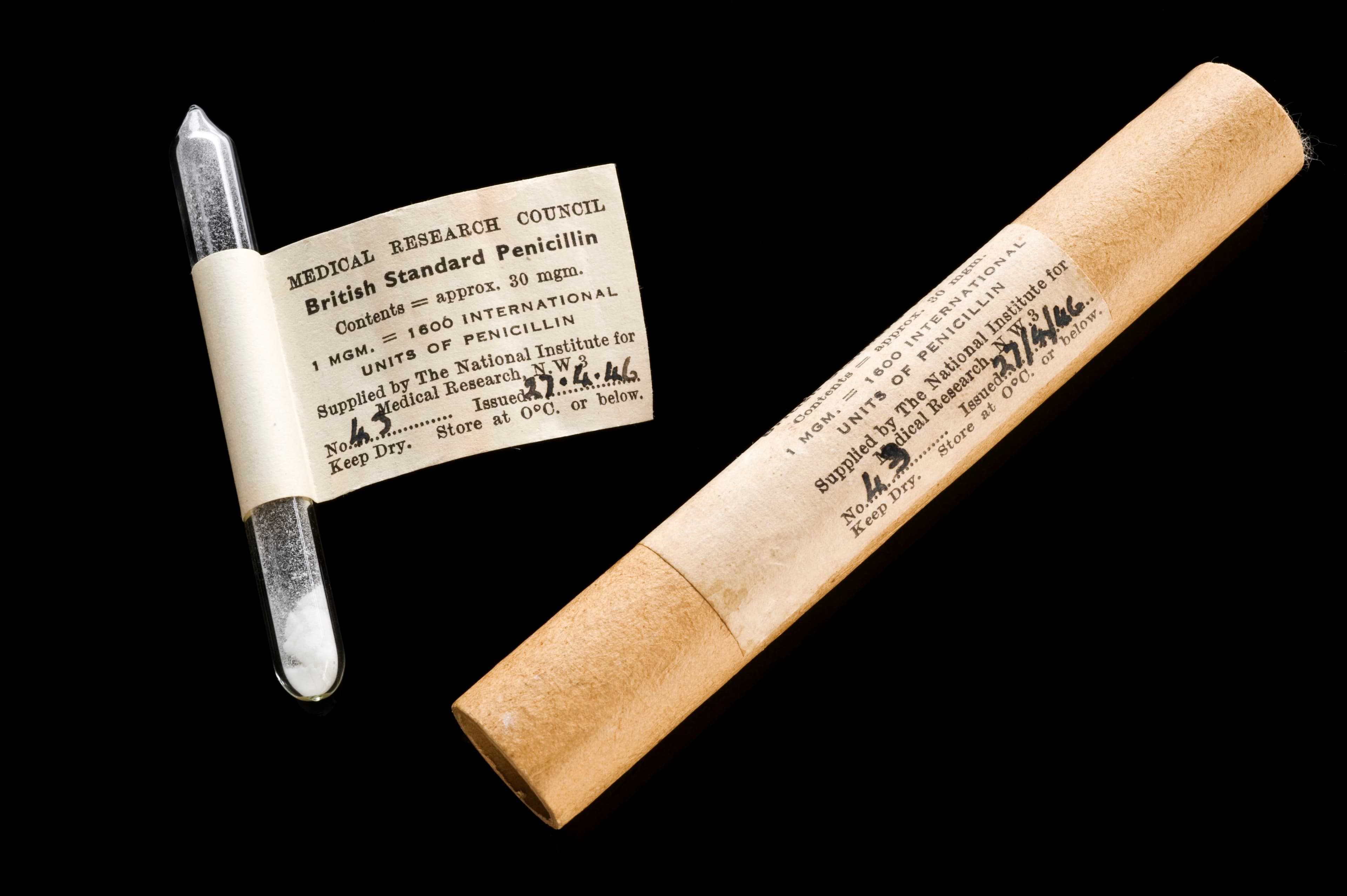
The penicillin story gets flattened too easily into one lucky culture plate and one brilliant observer. Fleming deserves his place in it, but the fuller story is messier and more useful. The real transformation happened when an unstable antibacterial substance had to be purified, tested, manufactured, and delivered in the middle of a world war. That is when penicillin stopped being a laboratory curiosity and became medical infrastructure.
Historical scene
Fleming's 1928 observation was important, but for years penicillin remained chemically awkward and hard to scale. The Oxford group led by Howard Florey and Ernst Chain, with crucial work by Norman Heatley and others, turned back to it in the late 1930s. This was not elegant bench science alone. It was bowls, vessels, extraction tricks, freeze-drying, assay work, and a lot of improvisation. Early supplies were so scarce that every milligram felt strategic.
What happened
Once penicillin showed real activity in animals and then in desperate human infections, the bottleneck became production. War changed the urgency. British and American teams pushed on cultivation methods, strain selection, purification, and deep-tank fermentation until the drug could be made at a scale the clinic and the battlefield could actually use. The story is often told as discovery followed by triumph, but the more honest version is discovery followed by an industrial sprint.
Why it changed infectious diseases
Penicillin helped prove that bacterial infection could be attacked with a targeted drug strong enough to change outcomes in conditions that had often been lethal. It also reset expectations. Before antibiotics, clinicians managed many severe infections with drainage, supportive care, and hope. After penicillin, there was a new standard: a pathogen might not just be described or endured, but directly suppressed. That changed bedside medicine, military medicine, and the entire future of antimicrobial discovery.
Why translation beats discovery alone
Penicillin corrects a common myth about medical breakthroughs. Discovery is only the first hill; translation is the mountain. A molecule changes care only when purification, standardization, manufacturing, and distribution are strong enough to carry it.
References
Fleming A. On the antibacterial action of cultures of a Penicillium, with special reference to their use in the isolation of B. influenzae. Br J Exp Pathol. 1929;10(3):226-236.
Chain E, Florey HW, Gardner AD, et al. Penicillin as a chemotherapeutic agent. Lancet. 1940;236(6104):226-228.
Bud R. Penicillin: Triumph and Tragedy. Oxford University Press; 2007.