HistorID
The Delayed Flight That Found a Virus
Barr noticed that Epstein was throwing out cells that were still alive. Then a flight from Uganda got stuck in fog, and a sample that should have been ruined turned out to be exactly what they needed.
The discovery of EBV proved that viruses could cause human cancer. It also proved something simpler: sometimes the person who can keep cells alive matters as much as the person with the hypothesis.
In 1961, a lecturer from Uganda stood before an audience in London and showed a map. Denis Burkitt had been documenting aggressive jaw tumors in African children — tumors that grew fast, killed young, and followed a geographic belt that overlapped neatly with the malaria map. It looked like the work of an infectious agent. In the audience sat Anthony Epstein, a pathologist who had spent years studying cancer-causing viruses in chickens. He walked out of that lecture with a new fixation: find the virus behind Burkitt lymphoma.
Historical Scene
The early 1960s were not friendly to the idea that human cancers could be viral. Animal tumor viruses were well established — Rous sarcoma virus in chickens, Shope papillomavirus in rabbits — but the jump to humans felt implausible to most cancer biologists. Epstein disagreed. He secured NIH funding, established a collaboration with Burkitt to fly fresh tumor biopsies from Kampala to London, and set to work. For two years, he tried to culture the lymphoma cells. For two years, they died in the dish.
In 1963, Epstein used his grant to hire a research assistant. He chose Yvonne Barr, an Irish zoologist who had graduated from Trinity College Dublin and spent the intervening decade building an unusually strong set of laboratory skills: cell culture work on the leprosy bacterium at the National Institute for Medical Research in London, then viral work on canine distemper at the University of Toronto. Epstein's second hire was Bert Achong, a Trinidad-born electron microscopist with a reputation for precision imaging. The three of them — the pathologist chasing a hunch, the cell culture specialist, and the man behind the microscope — would form the team that finally made the discovery.
What Happened
Barr saw the problem quickly. Epstein had been checking his cultures for signs of growth and discarding anything that did not look obviously viable. But Barr had spent years coaxing difficult cells to grow. She recognized that the discarded material still contained living cells — they just needed more time and gentler handling. Her cell culture methods gave the lymphoma cells the conditions they needed to survive.
Then came the fog. On a winter night in December 1963, a flight from Entebbe carrying fresh tumor biopsies was meant to land at Heathrow. Thick fog over London forced a diversion to Manchester. By the time the samples reached the Middlesex Hospital lab, the transport medium looked cloudy. Everyone assumed bacteria had contaminated it — the sample was ruined.
Under the microscope, Barr saw something different. The cloudiness was not bacteria. It was an enormous number of viable, free-floating lymphoma cells — suspended in the fluid, alive, and dividing. The delay and the agitation of the diverted journey had physically shaken tumor cells loose from the tissue. It was an accident that produced what deliberate effort could not: the first continuous suspension culture of human lymphocyte-derived cells. They called it the EB cell line.
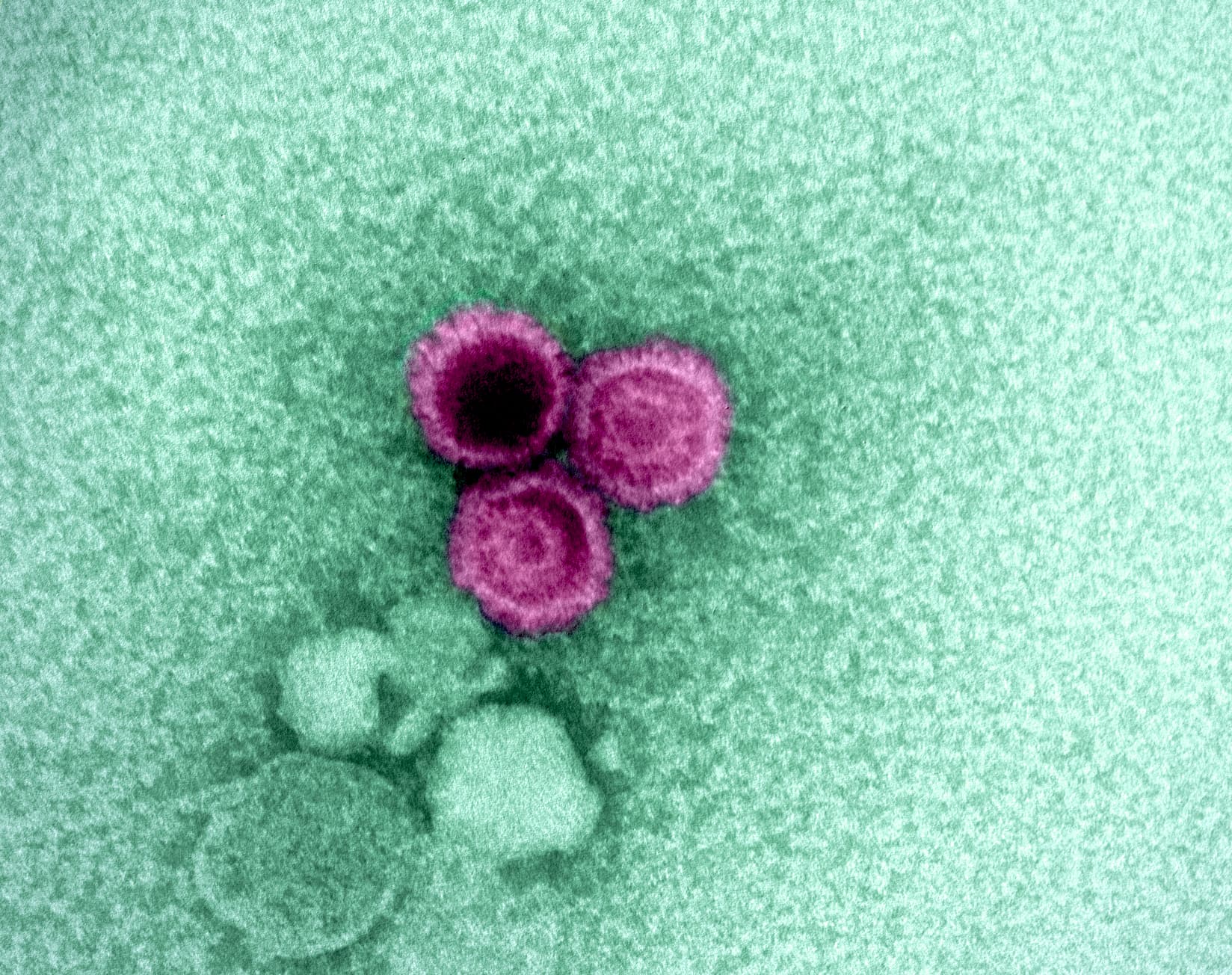
Achong prepared the cells for electron microscopy. In February 1964, the images came back. Inside the cultured lymphoblasts, Epstein identified particles with the unmistakable morphology of a herpesvirus — icosahedral capsids, enveloped virions, roughly 120 nanometers across. No one had ever seen viral particles in a human tumor before. The paper, "Virus particles in cultured lymphoblasts from Burkitt's lymphoma," appeared in The Lancet on March 28, 1964. Authors: Epstein, Achong, and Barr.
Barr continued the work. In 1965, she was a co-author on the follow-up paper in The Journal of Experimental Medicine that characterized the virus's morphology and biological properties in detail — the definitive description of what was now being called Epstein-Barr virus. She received her PhD from the University of London in 1966. That same year, she married, moved to Australia, and applied for research positions. None materialized. Yvonne Barr, the scientist whose cell culture expertise made the discovery possible, spent the rest of her career teaching physics, biology, chemistry, and mathematics at private high schools in Melbourne. She died in 2016 at age 83. It took until March 2024 — when The New York Times featured her in its "Overlooked No More" series — for her central role to be broadly recognized.
Why It Changed Infectious Diseases
EBV was the first virus shown to cause cancer in humans. That single fact cracked open a new field: human tumor virology. Before 1964, the link between viruses and human cancer was speculative. Afterward, it was a research program. Hepatitis B virus and hepatocellular carcinoma, human papillomavirus and cervical cancer, human herpesvirus 8 and Kaposi sarcoma — all of these discoveries trace their intellectual lineage back to a lab in Middlesex Hospital where three researchers looked at an electron micrograph and saw something they were not supposed to see.
The discovery also changed how clinicians understood the virus itself. In 1968, Werner and Gertrude Henle's lab at the University of Pennsylvania showed that EBV caused infectious mononucleosis — a disease that had puzzled physicians for decades. A technician in the Henle lab who lacked EBV antibodies developed classic mono, and the seroconversion told the story. Suddenly a single virus connected an African childhood cancer, a common adolescent illness, and a paradigm shift in oncology.
Why It Still Matters Now
EBV infects more than ninety percent of adults worldwide. It persists for life in memory B cells, reactivates periodically, and is shed in saliva. It causes infectious mononucleosis in a third to half of adolescents who acquire it. It is tightly linked to Burkitt lymphoma, Hodgkin lymphoma, nasopharyngeal carcinoma, gastric cancer, post-transplant lymphoproliferative disorder, and oral hairy leukoplakia in HIV. In 2022, a study of ten million US military personnel over twenty years showed that recent EBV infection increased the risk of developing multiple sclerosis thirty-two-fold — the strongest causal link yet between a virus and MS. The World Health Organization estimates roughly two hundred thousand cancers per year are attributable to EBV.
There is no approved vaccine. None of the candidates tested so far have prevented EBV infection. The virus's complex latency programs, its manipulation of B cell biology, and the fact that it rarely causes severe disease in childhood — when the immune system handles it without drama — make vaccine development uniquely difficult.
And then there is the quieter lesson of the discovery itself. Anthony Epstein had the hypothesis, the grant, and the name on the virus. But he could not grow the cells. Yvonne Barr could. She saw what he was discarding and knew it was still alive. Bert Achong knew how to reveal what was inside them. Three people with three different kinds of expertise, and the discovery needed all three. Infectious diseases history is full of stories like this — the lab scientist, the field clinician, the microscopist, the student technician — and only some of their names make it into the virus.
References
Epstein MA, Achong BG, Barr YM. Virus particles in cultured lymphoblasts from Burkitt's lymphoma. Lancet. 1964;1(7335):702-703.
Epstein MA, Henle G, Achong BG, Barr YM. Morphological and biological studies on a virus in cultured lymphoblasts from Burkitt's lymphoma. J Exp Med. 1965;121(5):761-770.
Epstein A. Burkitt lymphoma and the discovery of Epstein-Barr virus. Br J Haematol. 2012;156(6):777-779.
McGrath P. Cancer virus discovery helped by delayed flight. BBC News. April 6, 2014.
Ricks D. Overlooked No More: Yvonne Barr, who helped discover a cancer-causing virus. The New York Times. March 21, 2024.
Link: https://www.nytimes.com/2024/03/21/obituaries/yvonne-barr-overlooked.html