HistorID
The Bacillus That Inherited an Ancient Stigma
Mycobacterium leprae sounds like a neat laboratory label, but the word packed inside it is much older than the microscope. By the time the bacillus got its name, lepra had already been carrying centuries of fear.
This is what makes the naming story worth stopping for. The microbe was new to science, but the word attached to it was old, visual, and socially loaded from the start.
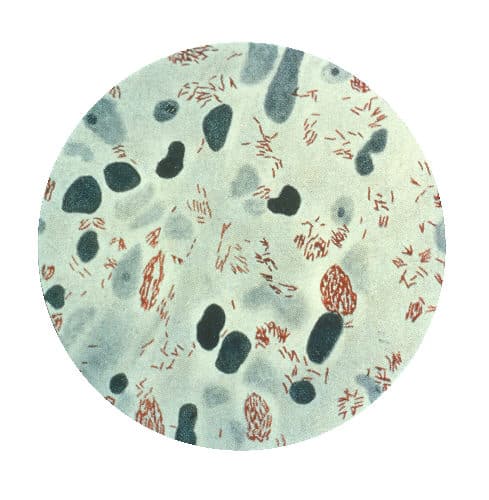
Mycobacterium leprae looks tidy on the page. Genus, species, italics, done. But the second word is doing more work than it first appears to. Lepra was around long before anyone knew a bacillus was involved. It came out of older Greek and Latin language for skin that looked rough, scaly, scabby, or peeling. In other words, the name began as a look before it ever became a microbe.
Historical scene
That matters because old disease names were usually built from surfaces. What the skin looked like. What a limb looked like. What a face looked like after years of disease. They were visual groupings, not microbiologic ones, and they were often broad. One old label could gather very different conditions together simply because the lesions seemed to rhyme. Even in later English, lepra could overlap with other scaly skin disorders, including psoriasis. The word was never clean.
What happened
Then bacteriology arrived and forced a much narrower question. In Bergen, in 1873, Gerhard Armauer Hansen identified the rod-shaped organism in tissue from patients with leprosy, making this one of the earliest moments when a long-feared disease was pinned to a specific bacterium. The naming history is a little less tidy than the discovery story. LPSN traces the old basonym to Bacillus leprae and explains the species epithet plainly: leprae is the Latin genitive, meaning "of leprosy." So the later binomial Mycobacterium leprae amounts to the mycobacterium of leprosy.
The irony is hard to miss. Hansen gave medicine a pathogen. The pathogen inherited a very old word. All the dread already attached to lepra did not vanish just because the microscope had improved.
Why it changed infectious diseases
This was not just a taxonomic clean-up. It was part of the larger shift from appearance-based medicine to cause-based medicine. A disease that had been wrapped for centuries in heredity, curse, contamination, and social dread was being pulled into the microbial era. That did not solve everything. M. leprae still refused to cooperate in easy ways. It could not be cultured in ordinary cell-free media, it grew extraordinarily slowly, and its transmission stayed murky. But once the bacillus was in view, the disease could no longer live only as metaphor.
Why the old word still matters now
Modern medicine still lives with the afterlife of old names. CDC now spends real effort undoing myths about leprosy because the social fear has outlasted the microbiology. The disease is hard to spread, treatable, and far less contagious than its reputation suggests, but the language keeps dragging history into the room. Genomics adds one more twist. M. leprae is remarkably conserved, and its phylogeography suggests that humans carried it across migration routes and then across colonial worlds; in some places, armadillos later complicated that map. The organism moved. The stigma traveled with it.
References
LPSN. Mycobacterium leprae. Formal species entry giving the etymology of leprae as the Latin genitive meaning "of leprosy."
Harper D. Leper and leprosy. Online Etymology Dictionary. Entries tracing the words to Late Latin lepra and Greek lepra / lepros, with the sense of scaly, scabby, rough, or peeling skin.
Centers for Disease Control and Prevention. About Leprosy (Hansen's Disease). CDC; updated 5 December 2025.
Singh P, Cole ST. Mycobacterium leprae: genes, pseudogenes and genetic diversity. Future Microbiol. 2011;6(1):57-71.
Encyclopaedia Britannica. Leprosy and Armauer Hansen. Historical and modern framing for the disease, stigma, and the 19th-century discovery of the bacillus.
CDC Public Health Image Library. Mycobacterium leprae photomicrograph, PHIL #2123.