HistorID
False Unit, Real Problem
Pseudomonas means 'false unit' in Greek. Walter Migula, a German bacteriologist at the Karlsruhe Technical Institute, coined the genus name in 1894 because he thought these Gram-negative rods were single-celled protozoa. The species name, aeruginosa, is Latin for verdigris, the blue-green patina of weathered copper. It describes the pigment the colonies produce on an agar plate. Neither name captures what actually makes this bacterium dangerous: it can eat crude oil. And anything that can eat oil can eat almost anything else.
Pseudomonas was named by Walter Migula in 1894 from the Greek pseudes (false) and monas (unit), because he mistook the bacteria for protozoa. The species epithet aeruginosa means verdigris in Latin, describing the blue-green pigment produced by pyocyanin and pyoverdin. Pseudomonas aeruginosa is defined by metabolic versatility. It can use more than 75 organic compounds as sole carbon sources, including hydrocarbons such as crude oil, jet fuel, benzene, and toluene. The same broad-spectrum oxygenase enzymes that degrade oil also degrade antibiotics. Combined with powerful efflux pumps and a low-permeability outer membrane, P. aeruginosa is intrinsically resistant to many antimicrobials. In 1980, Pseudomonas putida became the first patented living organism when Ananda Chakrabarty engineered a strain to degrade multiple crude oil components in Diamond v. Chakrabarty.
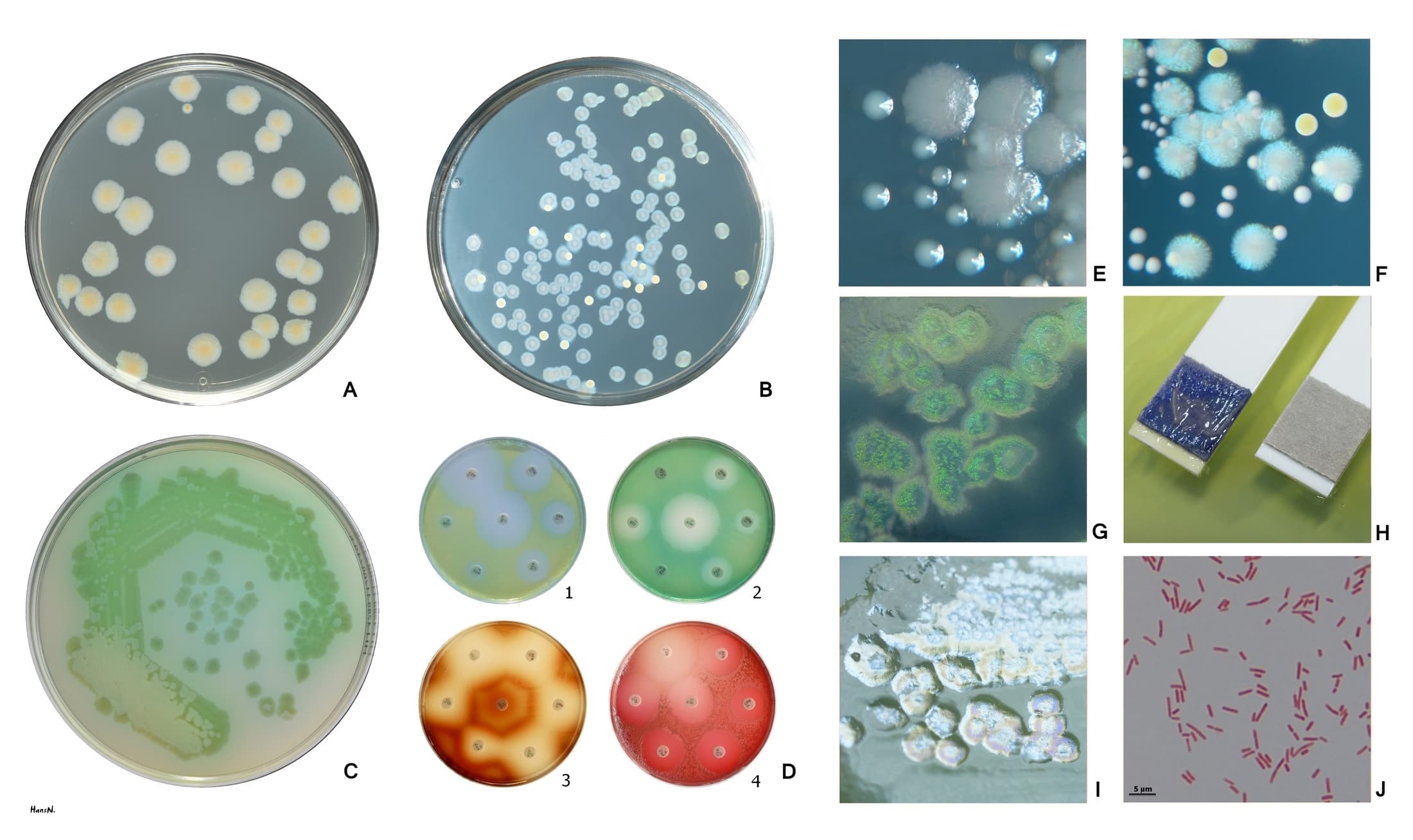
Pseudomonas means "false unit" in Greek. Walter Migula, a German bacteriologist at the Karlsruhe Technical Institute, coined the genus name in 1894 because he thought these Gram-negative rods were single-celled protozoa. He was, as the name suggests, wrong. The species name, aeruginosa, is Latin for verdigris, the blue-green patina of weathered copper. It describes the pigment the colonies produce on an agar plate: pyocyanin, a blue phenazine compound, combined with pyoverdin, a yellow-green siderophore. Neither name captures what actually makes this bacterium dangerous. It can eat crude oil. And anything that can eat oil can eat almost anything else, including the antibiotics you use to kill it.
Historical scene
Migula was working at the intersection of bacteriology and botany. His 1894 System der Bakterien attempted to bring taxonomic order to the rapidly expanding catalog of microorganisms being discovered across European laboratories. He separated bacteria by morphology, motility, and pigment production. The organisms he placed in the genus Pseudomonas shared a few traits: they were rod-shaped, motile by polar flagella, Gram-negative, and often produced fluorescent pigments. Migula's classification was morphological, not metabolic. He could not have known that the bacteria in this genus shared something far more consequential than shape or color. They shared an appetite.
What happened
The clinical significance of Pseudomonas aeruginosa was recognized early. By the 1890s, surgeons noted that wound infections with the organism produced a distinctive blue-green pus, a finding dramatic enough that the bacterium acquired the colloquial name "Bacillus pyocyaneus," the blue-pus bacillus. But the metabolic scope of the genus took much longer to appreciate.
Over the course of the twentieth century, microbiologists discovered that Pseudomonas species could degrade an astonishing range of organic compounds. The key was broad-spectrum oxygenases, enzymes that insert oxygen atoms into otherwise recalcitrant carbon bonds. Alkane hydroxylase attacks linear hydrocarbons. Catechol dioxygenase cleaves aromatic rings. These enzymes give Pseudomonas the ability to use crude oil, diesel, jet fuel, benzene, toluene, xylene, naphthalene, and hundreds of other compounds as sole carbon and energy sources. The organism does not merely tolerate hydrocarbons. It metabolizes them.
The environmental implications were obvious. A bacterium that eats oil is a natural tool for cleaning up oil spills. In the 1970s, Ananda Chakrabarty, a microbiologist at General Electric, took this reasoning further. Different Pseudomonas strains could degrade different hydrocarbon fractions, but no single strain could break down the full complexity of crude oil. Chakrabarty used plasmid transfer to combine four degradative pathways, encoding enzymes for camphor, octane, xylene, and naphthalene degradation, into a single strain of Pseudomonas putida. He filed a patent. The U.S. Patent Office rejected it on the grounds that living organisms were not patentable subject matter. Chakrabarty appealed. In 1980, the United States Supreme Court ruled 5 to 4 in Diamond v. Chakrabarty that a living, genetically modified microorganism could be patented. Chief Justice Warren Burger wrote for the majority that the bacterium was "a manufacture or composition of matter" within the meaning of patent law, and that the relevant distinction was not between living and inanimate things but between products of nature and products of human ingenuity. Pseudomonas had reshaped intellectual property law before it was ever deployed at an actual oil spill.
The genomic explanation for the metabolic versatility came in 2000, when the complete genome of Pseudomonas aeruginosa strain PAO1 was published. At 6.3 million base pairs, it was the largest bacterial genome sequenced up to that point. It contained 5,570 predicted genes, including a disproportionately large number of transcriptional regulators and transport systems. More than 8 percent of the genome was dedicated to regulatory functions, roughly double the proportion seen in Escherichia coli. The genome confirmed what microbiologists had suspected for decades: Pseudomonas is built to sense, transport, and metabolize almost any carbon source it encounters. It is a generalist in a world of specialists.
Why it changed infectious diseases
The same metabolic machinery that lets Pseudomonas degrade hydrocarbons also explains its clinical behavior. The outer membrane has low permeability, with porins that restrict the entry of many hydrophilic antibiotics. The genome encodes multiple efflux pump systems, most notably MexAB-OprM and MexXY-OprM, that actively expel beta-lactams, fluoroquinolones, tetracyclines, chloramphenicol, and aminoglycosides from the cell. AmpC beta-lactamase provides intrinsic resistance to many penicillins and cephalosporins. Acquired carbapenemases render last-line beta-lactams useless.
The environmental versatility is the clinical problem. P. aeruginosa can grow in distilled water. It can grow in disinfectant solutions including quaternary ammonium compounds and chlorhexidine if the concentration is suboptimal. It colonizes hospital sinks, ventilator circuits, contact lens solution, and the inside of diesel tanks. It does not need a host to survive, and it does not need a specialized niche. It needs moisture and a carbon source, and the carbon source can be almost anything. This is why P. aeruginosa causes roughly 10 percent of all nosocomial infections. This is why it is the leading cause of ventilator-associated pneumonia. This is why it colonizes the thickened, dehydrated mucus of cystic fibrosis airways and, once established, cannot be eradicated. The biofilm mode of growth, in which bacteria encase themselves in alginate, a polysaccharide matrix, makes systemic antibiotics effectively irrelevant. The organism is not resistant because it acquired a gene from another bacterium. It is resistant because it evolved to survive in soil, in water, in oil, and on surfaces where other bacteria die.
Why it still matters now
The World Health Organization lists carbapenem-resistant Pseudomonas aeruginosa as a critical-priority pathogen, the highest tier in its antibiotic resistance threat classification. Multidrug-resistant strains are rising globally, with some regions reporting carbapenem resistance rates above 50 percent. The antibiotic pipeline offers limited relief. Ceftolozane-tazobactam and ceftazidime-avibactam restore activity against some resistant strains but are vulnerable to metallo-beta-lactamases. Cefiderocol, a siderophore cephalosporin that hijacks the bacterium's own iron uptake system, represents a novel mechanism, but clinical data remain limited and resistance has already been reported. The story of Pseudomonas antimicrobial development is a narrowing spiral: each new drug class selects for resistance, and the organism's intrinsic metabolic flexibility means it can adapt to almost any chemical challenge.
The name Pseudomonas means "false unit." The species name aeruginosa means "verdigris." Both are descriptive, and both are incomplete. The real name for this organism, if naming were based on what it does rather than what it looks like, would describe its appetite. It was a bacterium that learned to eat oil, and everything else followed from that.
References
Migula W. Über ein neues System der Bakterien. Arb Bakteriol Inst Karlsruhe. 1894;1:235-238.
Migula W. System der Bakterien. Vol. 2. Jena: Gustav Fischer; 1900. pp. 873-892.
Chakrabarty AM. Plasmids in Pseudomonas. Annu Rev Genet. 1976;10:7-30.
Diamond v. Chakrabarty, 447 U.S. 303 (1980). Supreme Court of the United States.
Stover CK, Pham XQ, Erwin AL, et al. Complete genome sequence of Pseudomonas aeruginosa PAO1, an opportunistic pathogen. Nature. 2000;406(6799):959-964.
Lister PD, Wolter DJ, Hanson ND. Antibacterial-resistant Pseudomonas aeruginosa: clinical impact and complex regulation of chromosomally encoded resistance mechanisms. Clin Microbiol Rev. 2009;22(4):582-610.