When a self-limited skin infection is anything but
Clinical Vignette
A 72-year-old woman from a remote Amerindian community in the Amazon lowland of Colombia is brought to medical attention because of progressive immobility and severe pain involving both feet. Over the past several months, she has become increasingly unable to stand or walk and now spends most of the day resting in a hammock.
She lives in a small hut without a solid floor and has limited access to food and medical care. Several dogs live in close contact with her household. Because of chronic knee pain, she rarely leaves the dwelling and frequently places her feet directly on the dirt floor. Family members report that similar lesions have occurred intermittently for years but have worsened markedly over time.
Physical examination reveals hundreds of embedded nodular lesions involving the soles, lateral aspects of the feet, and interdigital spaces. Many lesions are closely packed and layered on top of one another, with surrounding hyperkeratosis and areas of necrosis. Similar clusters of lesions are noted at the ankles and knees. A strong malodor is present. The patient appears cachectic and dehydrated.
Laboratory evaluation shows severe anemia and mild leukocytosis. Examination of several lesions demonstrates viable ectoparasites embedded in the superficial layers of the skin.
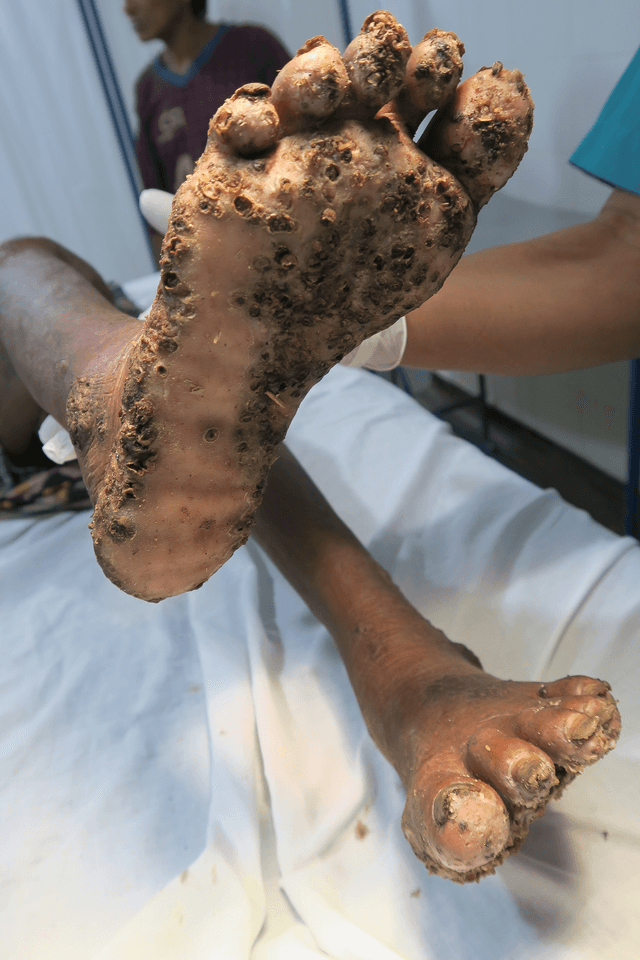
Source:
PLOS Neglected Tropical Diseases
Question
Which of the following is the most likely diagnosis?
Select one answer to view the rationale and peer response data.
Rationale locked
Answer the question above to reveal the rationale.
Rationale locked
Answer the question above to reveal the rationale.
References
Miller H, Ocampo J, Ayala A, Trujillo J, Feldmeier H. Very severe tungiasis in Amerindians in the Amazon lowland of Colombia: A case series. PLoS Neglected Tropical Diseases. 2019;13(2):e0007068.